Big Houses vs. Small Growers: Your Guide to Champagne’s Power Players
Confused by champagne options? Learn when to choose big houses like Veuve Clicquot vs. grower champagnes. Complete shopping guide with recommendations for every budget.
Part 4 of our 4-part Champagne series
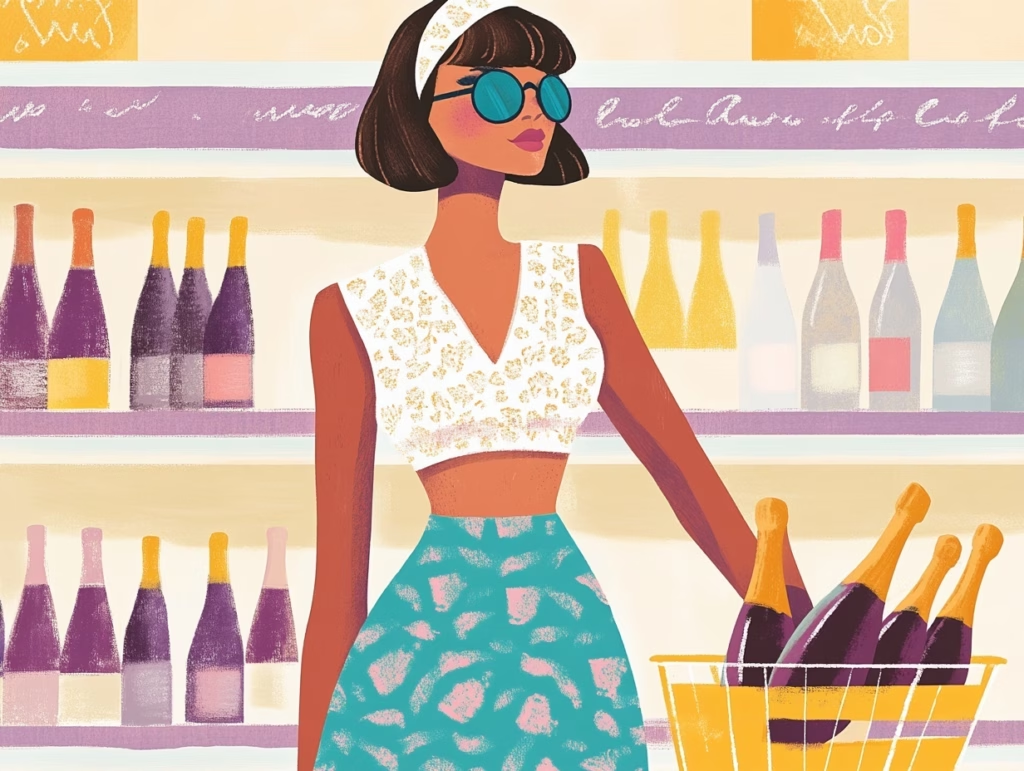
You’ve learned the history, mastered the technical magic, and decoded the terroir—now comes the fun part: choosing your champagne. But here’s where things get interesting: the champagne world is basically split between massive luxury houses with centuries of marketing muscle and small family growers making bottles you’ve probably never heard of but that might blow your mind.
It’s like choosing between shopping at Saks (reliable, consistent, beautifully packaged) versus discovering that amazing vintage boutique (unique finds, personal stories, sometimes incredible deals). Both have their place in your champagne wardrobe, but understanding the difference helps you shop smarter and drink better.
How We Got Here: The Rise of the Houses and the Grower Revolution
The House System: Building Champagne Empires
Back in the 18th and 19th centuries, most Champagne growers were farmers, not winemakers. They sold their grapes to négociants (merchant houses) who had the capital, cellars, and connections to turn those grapes into finished champagne and sell it worldwide.
Why the House System Made Sense:
- Capital Requirements: The méthode champenoise requires expensive equipment and years of aging
- Blending Expertise: Houses could source from multiple villages to create consistent styles
- Distribution Networks: Global marketing and shipping infrastructure
- Risk Management: Houses could weather bad vintages by blending across regions and years
The big houses became household names by investing heavily in marketing, creating signature styles, and building luxury brands that transcended wine. When you think “celebration,” you think Dom Pérignon or Veuve Clicquot—not because they’re necessarily the best, but because they’ve been brilliant at selling the dream.
The Grower Awakening: Taking Control
Starting in the 1960s and accelerating through the 2000s, something shifted. Grower families who had been selling grapes for generations started thinking: “Wait, why are we letting other people make all the profit (and get all the credit) for our fruit?”
The Grower Revolution Drivers:
- Higher Margins: Selling bottles instead of grapes means 5-10x more profit
- Creative Control: Making wine exactly how they want, not how a house blender dictates
- Terroir Expression: Showcasing specific vineyard sites instead of blending everything together
- Direct Relationships: Building connections with wine lovers who appreciate their craft
Today, about 15,000 growers farm in Champagne, but only around 4,000 make their own wine. The rest still sell to houses—creating a complex web of relationships that shapes every bottle.
The Major Champagne Houses: Who Owns What
The champagne house landscape looks like a luxury conglomerate family tree, where centuries-old names have been bought, sold, and consolidated into massive empires. What started as family businesses selling wine to European aristocrats has evolved into global luxury brands worth billions. Understanding who owns what helps decode not just the bottles on the shelf, but the business strategies behind your favorite fizz.
LVMH Empire
- Flagship Brands: Moët & Chandon, Dom Pérignon, Veuve Clicquot, Krug, Ruinart, Mercier
- Style Philosophy: Luxury positioning, consistent house styles, global reach
- What They Own: The biggest player, controlling about 25% of champagne production
When Bernard Arnault decided to build a luxury empire, champagne was always going to be a centerpiece. LVMH didn’t just buy champagne houses—they collected the most prestigious names in the region like rare art pieces. Today, walking down any champagne aisle means encountering their brands at every price point, from accessible luxury to “mortgage your house for this bottle” prestige cuvées.
Major LVMH Champagnes:
- Moët & Chandon: The volume king, accessible luxury, fruit-forward style (try: Moët & Chandon Impérial Brut (~$60), the classic crowd-pleaser)
- Dom Pérignon: Prestige cuvée only, vintage-focused, premium positioning (try: Dom Pérignon Vintage (~$300), when you want to splurge on a legend)
- Veuve Clicquot: Bold, rich style, iconic yellow label, strong brand personality (try: Veuve Clicquot Yellow Label Brut (~$70), structured, toasty, instantly recognizable)
- Krug: Ultra-premium, unique vinification in small oak barrels, no malolactic fermentation (try: Krug Grande Cuvée (~$300), the thinking person’s champagne)
- Ruinart: Historic house (founded 1729), elegant Chardonnay-focused style (try: Ruinart Blanc de Blancs (~$120), pure Chardonnay elegance)
Pernod Ricard Group
- Flagship Brands: Perrier-Jouët, Mumm, Martell (Cognac cross-over)
- Style Philosophy: Accessible luxury, strong hospitality focus
- Market Position: Second-largest player, strong in duty-free and hospitality
While LVMH went for the crown jewels, Pernod Ricard took a different approach—building a spirits empire that happens to include some serious champagne players. Think of them as the hospitality kings who understand that champagne isn’t just about luxury, it’s about creating experiences. Their champagne houses often show up in hotels, airlines, and events where consistent quality and broad appeal matter more than prestige positioning.
- Mumm: Sports partnerships, accessible luxury, consistent quality (try: G.H. Mumm Cordon Rouge Brut (~$65), reliable, rich, nutty character)
- Perrier-Jouët: Floral, elegant style, art nouveau aesthetic, Belle Epoque prestige cuvée (try: Perrier-Jouët Grand Brut (~$65), delicate, floral, perfect for those who find other champagnes too bold)
Rémy Cointreau
- Flagship Brand: Champagne Louis Roederer (independent), but they own Piper-Heidsieck and Charles Heidsieck
- Style Philosophy: Traditional methods, focus on terroir expression
The cognac specialists who couldn’t resist adding some bubbles to their portfolio. Rémy Cointreau’s approach to champagne mirrors their spirits philosophy—fewer brands, but each one positioned as a premium offering with serious winemaking credentials. They’re the ones betting that quality and tradition will win over flashy marketing in the long run.
- Piper-Heidsieck: Red label recognition, cinema partnerships, accessible elegance (try: Piper-Heidsieck Brut (~$55), Pinot Noir-dominant, full-bodied, excellent value)
- Charles Heidsieck: Premium positioning, exceptional aging program, collector favorite (try: Charles Heidsieck Brut Réserve (~$55), sophisticated, well-aged complexity)
Independent Powerhouses
In a region increasingly dominated by luxury conglomerates, the remaining independent houses are like the cool local coffee shops that somehow compete with Starbucks. These family-owned companies have resisted buyout offers (some reportedly in the hundreds of millions) to maintain control over their winemaking and brand identity. They represent champagne’s artisanal soul in an increasingly corporate landscape.
Louis Roederer
The family that said “no thanks” to every acquisition offer and instead doubled down on quality and vineyard ownership. They’re the proof that independence can still win in the luxury game.
- Cristal: One of the most prestigious cuvées, distinctive clear bottle (try: Cristal, Brut ($400) bright yet refined, with notes of citrus and brioche)
- Roederer Collection: Non-vintage offering, exceptional quality-to-price ratio (try: Louis Roederer Collection 245 (~$45 for 375ml), sophisticated house style, excellent value for an independent producer)
Pol Roger
The house that Winston Churchill loved so much they named a cuvée after him. Still family-owned, still making wine the same way they did when they were supplying 10 Downing Street (try: Pol Roger Brut Réserve (~$70), elegant, balanced, royal-approved quality).
Bollinger
James Bond’s champagne of choice isn’t just movie product placement—it’s a family house that’s been perfecting their powerful, distinctive style since 1829 (try: Bollinger Special Cuvée (~$80), Pinot Noir-dominated, rich, powerful, iconic “Bolly” style).
Taittinger
The family that bought their house back from corporate ownership in 2006, proving that sometimes tradition is worth more than profit margins (try: Taittinger Brut La Française (~$70), Chardonnay-focused, elegant, light, refined).
Grower Champagnes: The Artisan Alternative
If the big houses are champagne’s luxury department stores, grower champagnes are the artisan boutiques tucked away on side streets—smaller, more personal, and often hiding incredible treasures. These are the family producers who decided to stop selling their grapes to the big names and start bottling their own stories instead.
Grower champagne represents everything the houses aren’t: unpredictable, terroir-driven, and deeply personal. Where a house blends away differences to create consistency, growers celebrate what makes their corner of Champagne unique. It’s the difference between a perfectly executed symphony and an intimate jazz performance—both beautiful, but completely different experiences.
The grower movement has exploded in recent decades as wine lovers have developed an appetite for authenticity and discovery. These producers often work plots that have been in their families for generations, bringing an intimacy to winemaking that’s impossible to replicate at industrial scale.
When you buy grower champagne, you’re not just buying a bottle—you’re buying into a family’s interpretation of their land.
What Makes Grower Champagne Different
- Terroir Expression: Instead of blending away differences, growers celebrate what makes their vineyard unique
- Personal Style: Family winemakers can experiment and create distinctive expressions
- Limited Production: Most growers make 10,000-50,000 bottles annually (versus millions for houses)
- Direct Connection: Often family members pour the wine and tell the story personally
The philosophy behind grower champagne is fundamentally different from the house approach. Instead of trying to make the same wine year after year, growers embrace vintage variation as a feature, not a bug. They want you to taste 2018’s unusual heat or 2021’s challenging conditions because that’s the story of their vineyard that year.
Most grower producers work on a scale that would be considered a rounding error for the major houses—we’re talking 10,000-50,000 bottles annually versus millions. This small scale allows for experimentation, personal attention to every detail, and winemaking choices that prioritize expression over marketability. It’s the difference between a chef cooking for 50 people versus running a chain restaurant.
Notable Grower Champagne Producers
Pierre Peters (Le Mesnil-sur-Oger): Blanc de Blancs specialist, pure Chardonnay expression from Grand Cru sites (try: Pierre Peters Cuvée de Réserve Blanc de Blancs (~$80), mineral-driven, age-worthy).
Egly-Ouriet (Ambonnay): Pinot Noir powerhouse, low-intervention winemaking, cult following (try: Egly-Ouriet Brut Grand Cru (~120), rich, vinous, powerful).
Jacques Selosse (Avize): Natural wine pioneer, experimental techniques, controversial but influential (try: Jacques Selosse Initial (~$150-200), oxidative style, polarizing but groundbreaking).
Laherte Frères (Chavot): Biodynamic farming, terroir-driven approach, exceptional value (try: Laherte Frères Ultradition Brut (~$45-55), organic, expressive, great entry point).
Marie-Courtin (Polisot, Aube): Female winemaker, organic farming, pure and mineral style (try: Marie-Courtin Blanc de Blancs (~$200), elegant, precise, sustainably made)
Geoffroy (Cumières): Family estate since 1850s, traditional methods, expressive site-specific bottlings (try: Geoffroy Brut Rosé de Saignée (~$50-60) – traditional method rosé, authentic terroir expression).
Pro Tip: Grower champagnes are often found at specialized wine shops rather than large retailers. Look for bottles marked “RM” (Récoltant-Manipulant) on the label to identify true grower producers.
Shopping Guide: Houses vs. Growers
When to Choose House Champagne
- Consistency: You know exactly what style you’re getting every time
- Availability: Easy to find at most wine shops and restaurants
- Gifting: Recognizable names that impress at dinner parties
- Food Pairing: Predictable styles that work with planned menus
- Special Occasions: Prestige cuvées for milestone celebrations
Price Range: $45-80 for non-vintage, $100-300+ for prestige cuvées
When to Choose Grower Champagne
- Discovery: Unique expressions you won’t find anywhere else
- Value: Often exceptional quality-to-price ratios
- Terroir Exploration: Taste specific vineyard sites and soil types
- Supporting Artisans: Direct support for family producers Wine Geek Credentials: Impress knowledgeable wine friends
Price Range: $35-120 for most offerings, exceptional values in $40-60 range
Shopping Strategies
For House Champagne:
- Shop sales at major retailers
- Look for older disgorgement dates for more complexity
- Try the entry-level offerings before splurging on prestige cuvées
For Grower Champagne:
- Find specialized wine shops with knowledgeable staff
- Ask about recent arrivals and staff favorites
- Try before you buy at wine bars with good selections
- Check Last Bubbles for daily specials on Champagne, often at deep discounts, including features on grower producers that can be hard to find elsewhere.
Stylistic Differences: What to Expect
House Style Characteristics
- Consistency: Tastes the same year after year
- Polish: Refined, smooth, accessible
- Blending: Complex assemblages from multiple sites
- Dosage: Often slightly higher to appeal to broad palates
- Aging: Extended lees aging for complexity
Grower Style Characteristics
- Vintage Variation: Each year tastes different based on weather
- Terroir Expression: Mineral, soil-driven flavors
- Single-Site Focus: Often from one vineyard or village
- Lower Dosage: Drier styles that showcase grape character
- Personal Touch: Reflects winemaker’s philosophy and style
The New Generation: Hybrid Approaches
Some producers are blurring the lines:
- Grower-Négociants: Family producers who buy some grapes to supplement their estate fruit
- House Vineyard Programs: Major houses investing in single-vineyard expressions
- Collaborative Projects: Houses partnering with growers for special releases
The Bottom Line: There’s Room for Both
The house versus grower debate isn’t really a competition—it’s about having options. Houses excel at creating consistent, polished wines that work for every occasion. Growers offer discovery, terroir expression, and often exceptional value.
Your champagne journey gets more interesting when you explore both worlds. Start with houses to understand classic styles, then venture into grower territory to discover what makes each corner of Champagne unique.
The best part? In a region as small and interconnected as Champagne, many growers sell fruit to houses while making their own wine, and some houses source from the same vineyards for their top cuvées. It’s all part of the beautiful complexity that makes champagne so endlessly fascinating.
The Ultimate Goal: Understanding enough about both approaches to choose the perfect bottle for every moment—whether that’s impressing your boss with Dom Pérignon or discovering your new favorite grower at Tuesday dinner.
Just tuning in? Check out my prior posts on Champagne then line up a major house with a grower bottle from the same region to taste the differences. Cheers!